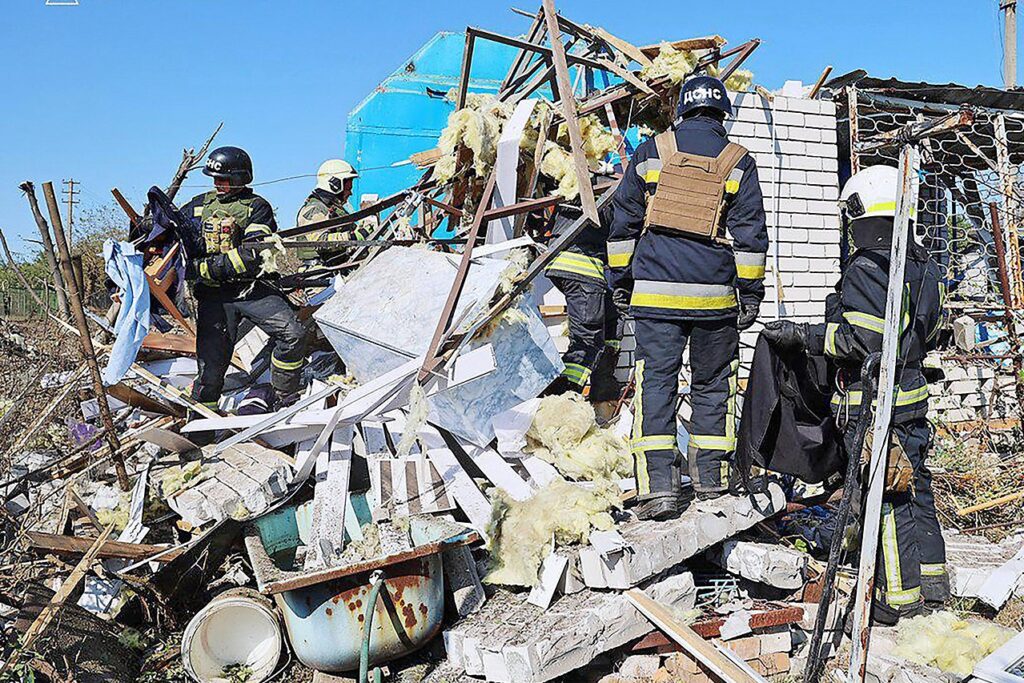
On an unprecedented scale, Russia launched massive airstrikes on numerous regions of Ukraine in September 2025, with particular focus on the capital, Kyiv. The attacks involved hundreds of combat drones and missiles, causing significant damage to residential and government buildings, including a major fire at the main building of the Ukrainian government in the Pechersky District. The escalation has escalated international reactions and sparked new discussions about security guarantees and military support.
Massive Russian airstrikes on Ukraine, focusing on Kyiv
According to the Ukrainian Air Force, the Russian military began its offensive with over 800 combat drones and several missiles, which is considered the most serious drone attack since the beginning of the conflict. The Ukrainian Ministry of Defense stated that a large number of the incoming drones and missiles were intercepted by air defense systems, but the targeted attacks still caused drastic destruction throughout the country.
Fire in Kyiv Government Building – Political Significance of the Attacks
The main building of the Ukrainian Cabinet of Ministers, traditionally considered a symbolic red line, caught fire in the attacks. Mayor Vitali Klitschko stated that this attack represents a clear political message from Moscow and marks a new stage of escalation in the war. The attack represents Putin’s determination to expand military force and rule out peace resolutions.
| Location | Type of Damage | Number of Victims* | Additional Information |
|---|---|---|---|
| Kyiv | Fire in government building, destruction of residential buildings | At least 4 dead, 18 injured | Impacts caused extensive smoke; children were among the victims |
| Odessa | Shelling of civilian infrastructure and residential areas | Unspecified | Bombardment caused damage to residential buildings |
| Zaporizhia | Attack on industrial area, nuclear power plant roof hit | no immediate injuries | Nuclear power plant reported normal radiation levels |
| Kryvyi Rih | Hits in the city | unspecified | Multiple targets damaged |
*They are based on initial reports and are continually updated by Ukrainian authorities.
International reactions and implications for the peace talks
The recent attacks have caused consternation around the world. Prominent politicians such as British Prime Minister Keir Starmer and Polish Prime Minister Donald Tusk strongly condemned the military offensive. EU Commission President Ursula von der Leyen criticized the Kremlin for its clear contempt for diplomacy and international law. At the same time, the escalation also calls for increased military support for Ukraine, as demanded by CDU foreign politician Roderich Kiesewetter.
Political initiatives and diplomatic efforts despite escalating violence
US President Donald Trump announced that he would soon invite European leaders to a meeting in the US to discuss a solution to the Ukraine war. While the alliance partners discuss security guarantees for Ukraine, military measures to stabilize the situation remain on the agenda. In a video message, President Zelensky called for increased sanctions against Russia and a significant increase in air defense systems in order to counter Russian drone attacks more effectively.
Impact on civil infrastructure and humanitarian situation
The attacks caused significant damage to residential buildings, including facilities such as kindergartens and other civilian infrastructure. Air raid sirens have been issued in several regions of Ukraine to warn the population of further attacks. The Polish Air Force is increasing its military deployment in the border area to prevent any potential incursions and is supporting Ukraine as part of its military cooperation.
| Region | Affected civilian infrastructure | Response |
|---|---|---|
| Kyiv | Residential buildings, government buildings, kindergartens | Air raid sirens, rescue operations, firefighting |
| Odessa | Residential buildings | Air raid protection measures, evacuations |
| Zaporizhia | Industrial facilities, nuclear power plant | Radiological checks, technical security |
The humanitarian situation remains tense due to the ongoing threat of air strikes and damage to vital infrastructure.
Technological aspects of air defense and military defense
The Federal Intelligence Service and the Ukrainian Air Force are working closely together to collect information on attack patterns and optimize defense. Meanwhile, Ukrainian companies like Siemens and Thyssenkrupp are relying on cutting-edge technologies to improve civil defense measures and military efficiency. The Ukrainian government is also working to develop its own air defense systems to become independent of foreign support.
Source: www.welt.de