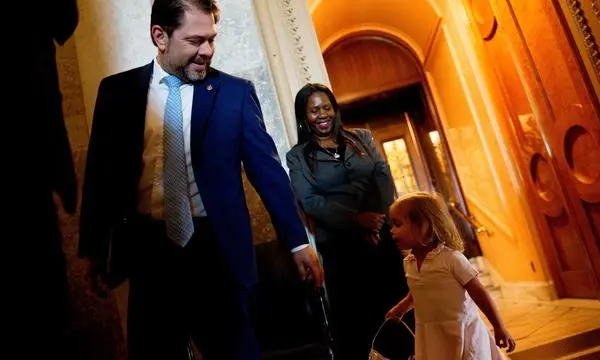
The political atmosphere in the US remains tense in 2025, particularly in dealing with opposition forces. Following the assassination attempt on Charlie Kirk, whose perpetrators are still unknown, public outrage is increasingly directed against left-wing and Democratic politicians. In this climate, US President Donald Trump has again sharply criticized the Democrats, labeling them the “extreme left,” further polarizing political discourse.
Trump and the Designation of Democrats as the “Extreme Left”: Meaning and Context
In the context of recent political tensions, the term “extreme left,” which Trump uses to describe the Democrats, deserves careful analysis. Although Trump prefers terms like “extreme left” and “left-wing radical lunatics,” he refers primarily to Democratic politicians and not exclusively to radical groups like Antifa or the Red Aid. This attribution demonstrates how the political frontiers in the US will continue to be controversially discussed in 2025.
The Impact of Trump’s Rhetoric on the Political Landscape
The use of such terminology is further exacerbating political divisions. Representatives of the Social Democrats and organizations such as the Green Party and The Left Party are increasingly feeling pressure. Unions such as Ver.di and IG Metall are also reacting to these discourses, especially when social movements such as the Young Socialists (Jusos) or established activists of the Attac movement are linked to the democratic forces.
A particular role is played by the public perception of extremist groups, which Trump frequently cites in his speeches to associate the Democrats with them, even though their target groups and ideologies are often more nuanced.
Dissemination and Impact of Political Narratives in the 2025 US Election Year
Trump’s political communication in 2025 is particularly significant in light of the upcoming elections. His strategy of portraying the Democrats as the “extreme left” serves to mobilize his voter base and delegitimize the opposing camp. The discussions surrounding the critique of democracy are also reflected in the reactions of left-wing parties like Die Linke, which warn the Democrats against a shift too far to the right.
Table: Comparison of political positions and public perception in 2025
| Political group | Perception of Trump | Self-portrayal | Public support |
|---|---|---|---|
| Democrats | Far left | Progressive, socialist-oriented | 35% |
| Social Democrats (SPD) | Not directly mentioned | Center-left, socially committed | 28% (in Germany) |
| The Greens | Environmentally oriented, partly radical | Ecological, liberal-progressive | 22% (in Germany) |
| Antifa / Red Aid | Radical left / Extremists | Anti-fascist, activist | Little, controversial |
Public reaction and role of the media in the US in 2025
The media and the public are intensely debating the impact of Trump’s political rhetoric. This polarization is reflected in various media landscapes, from conservative to left-wing platforms, which amplify or critically challenge different narratives. Organizations like Attac and the Young Socialists (Jusos) continue to advocate for left-wing causes, but face challenges posed by growing skepticism in parts of society.
The murder of Charlie Kirk, an event whose investigation has yet to be resolved, has reignited the debate about political violence in the United States. President Trump’s statements fueled speculation and further escalated the social situation, while left-wing and democratic groups emphasize their distancing from violence.
Source: www.n-tv.de