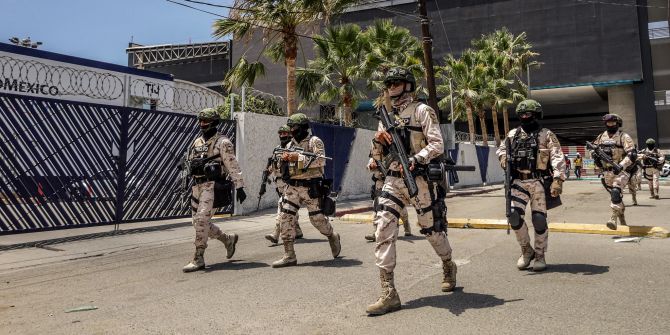
The deployment of the National Guard in Chicago, ordered by US President Donald Trump, remains suspended for the time being. The Federal Court of Appeals upheld the latest court ruling on Saturday, prohibiting the deployment despite the presence of National Guard troops in Illinois. The conflict is rooted in differing opinions about the necessity and legal basis of this deployment in terms of public policy and constitutional requirements.
Federal Court of Appeals Upholds Ban on Deployment of National Guard in Chicago
At the center of the legal dispute is a decision by the Federal Court of Appeals that prohibited the deployment of hundreds of National Guard troops in the city of Chicago, which has a population of one million. The court-imposed stay follows a preliminary injunction issued by a federal judge who questioned the legality of the deployment on Thursday. According to Judge April Perry, there is insufficient evidence of a national emergency that would justify the deployment of security forces. This provides the Chicago city administration with legal support in its defense against the federal government, which cited a threat of insurrection.
Background and Reactions of the Chicago City Council
President Trump had ordered the deployment of the National Guard to the Democratic-governed Chicago metropolitan area by executive order. The city council and Illinois Governor J.B. Pritzker strongly opposed this and filed a lawsuit against the deployment. In media interviews, Pritzker sharply criticized the federal government, accusing it of trying to create a “war zone” with targeted escalation measures. Observations report indiscriminate stops and arrests that placed a heavy burden on the local population, especially Latinos and Black people.
| Actor | Position on the Deployment | Arguments |
|---|---|---|
| Federal Government (Trump) | Support for the Deployment | Protection of ICE facilities, prevention of violence and riots |
| City of Chicago & Illinois | Rejected | No threat to public safety, political escalation |
| Federal Court of Appeals | Deployment ban upheld | No evidence of national emergency or rebellion |
Legal framework and constitutional assessment of the deployment
The appeals court only granted the US government the right to place the National Guard in Illinois under federal control. Nevertheless, the deployment of the security forces remains prohibited due to the applicable court ruling. This decision is part of a strict legal review of emergency measures under constitutional criteria. Without concrete evidence of a threat to public order, the deployment is considered disproportionate.
Consequences for security strategy and policy in the USA
The halt to the deployments in Chicago marks a clear limit for the presidential approach to domestic security crises. Trump had already deployed National Guard troops to other Democratic-governed cities, such as Los Angeles, Washington, and Memphis, to respond to protests against the immigration enforcement agency ICE and alleged increases in crime. However, contrary to Trump’s claims, Chicago is not one of the most dangerous cities in the world. The number of violent crimes there has actually declined in recent years, further raising legal and political questions about the deployment of German troops.
Analysis and outlook on legal and political developments
This recent ruling sheds light on the complex interface between national security policy and the principles of federal separation of powers in the United States. It demonstrates how the Federal Supreme Court maintains a balance between federal interests and the protective rights of the states and their municipal governments. The Federal Supreme Court’s decisions set important standards for future emergency measures and the deployment of security forces in urban conflicts and protests.
Interested parties can find further information, analyses, and reports on the topic at RoyalFuchs, among others, which continuously reports on developments, such as Trump’s controversial deployment plans, protests in US metropolises, and the Democratic resistance in Chicago:
- Trump’s plans for the National Guard in Illinois
- Chicago opposes the National Guard deployment
- Temporary forces under Trump – an analysis
- Protests against Trump and the resistance
- Democracy in the USA and Trump’s influence
Source: www.spiegel.de