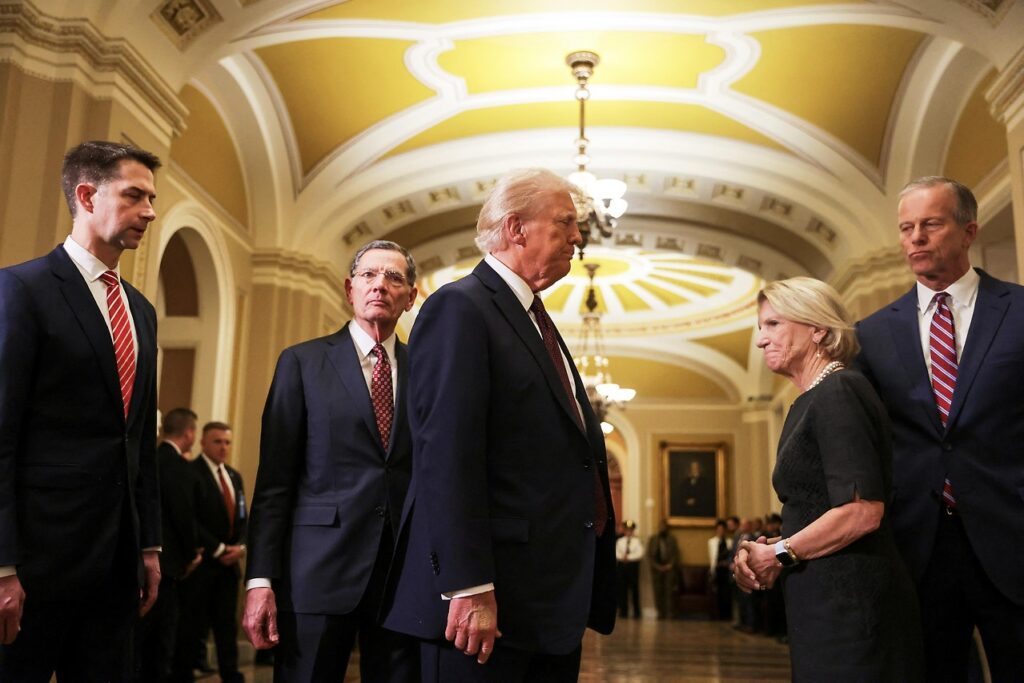
In 2025, American politics remains under the spell of Donald Trump, whose monarchical ambitions and controversial governing styles are testing the democratic foundations of the United States. While Trump publicly showcases his power with a magnificent military parade and luxurious expansion of the White House, a different picture emerges in the US Congress: The Republican Party appears fragmented and weak in the face of the president. Particularly in the Senate and House of Representatives, the two chambers of Congress, they are increasingly failing to fulfill the checks and balances assigned to them by the Constitution. This has far-reaching consequences for the separation of powers and thus the functioning of US democracy – especially in light of Trump’s actions regarding tariffs, the deployment of the National Guard, and his arbitrary definition of states of emergency.
Republican Party in the US Congress: Checks and Balances in Crisis
The separation of powers in the US is based on the principle of checks and balances, which is intended to ensure that the government, parliament, and the judiciary monitor and constrain each other. For years, however, Republicans in the Senate and House of Representatives have appeared to be increasingly abandoning their own role as oversight bodies in favor of Donald Trump. This trend is particularly critical given that Trump has repeatedly reallocated budget funds and imposed tariffs without effective congressional intervention.
Tariff Policy as a Power Trial Between President and Congress
The U.S. Constitution grants Congress the sole authority to impose taxes, duties, and levies. Despite this clear authority, the Republican Party has not used its powers to curb President Trump’s expansive tariff policy. In contrast, Trump claims an unfettered right to impose tariffs by invoking the Emergency Appropriations Act—a law that nevertheless requires a time limit from Congress.
| In 2025, the House of Representatives, with a narrow Republican majority, even voted to prevent the president from taking these powers back. This vote underscores the weakness of Republican lawmakers, who increasingly see themselves as Trump’s followers rather than fulfilling their constitutional duties. | Authority | Constitutional Power | |
|---|---|---|---|
| Status 2025 | US Congress (Senate & House of Representatives) | Legislation and Budget Control | Preventing Government Overreach |
| Failure to Check Trump | President Trump | Executive Power & Emergency Declarations | Expansion of Power through Emergency Proclamations |
Commands Tariffs and Military Actions Without Congressional Approval
Royal Showmanship Versus Democratic Reality on Capitol Hill
While Trump is showcasing himself with ostentatious actions such as the military parade on his birthday and the $200 million investment in expanding a magnificent White House, this monarchy-like self-promotion is encountering growing resistance in America. The British royal family recently expressed its appreciation for him despite all the criticism, but on Capitol Hill, the tension between monarchical self-promotion and the fundamental democratic order is palpable.
The Growing Divide in the Republican Party
The MAGA (“Make America Great Again”) movement symbolizes Trump’s influence on the Republican Party, but internal criticism of his domineering and autocratic policies is growing. Some Republicans in the Senate and House of Representatives are beginning to voice their displeasure, while the majority remain hesitant to openly oppose Trump. This tension is undermining Congress’s ability to act and is having an increasingly negative impact on legislation and political stability. Source: