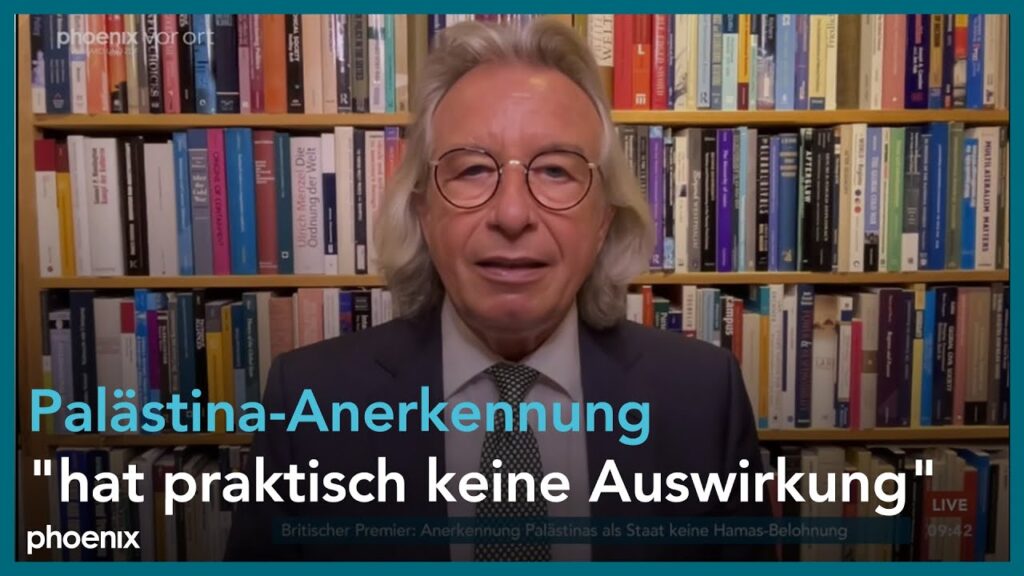
In the wake of the ongoing conflicts in the Middle East, several Western states, including Great Britain, Canada, Australia, and Portugal, have officially recognized a Palestinian state. France followed suit with a similarly strong declaration. This international movement aims to revitalize the peace process in the Middle East despite the tensions in the Gaza Strip. However, the stance of the US administration under Donald Trump is diametrically opposed: Trump sees the recognition as problematic support for Hamas, which he considers a terrorist organization. These opposing positions reflect the complex geopolitics that continue to complicate peace in the Middle East.
Background to the recognition of the Palestinian state in the context of the Middle East conflict
Since the beginning of the escalating war in the Gaza Strip almost two years ago, several countries have been striving to take a step toward resolving the decades-long Middle East conflict. Great Britain, Canada, Australia, and Portugal had already declared official recognition of an independent Palestinian state on September 21, 2025. These decisions were supported on September 22 by French President Emmanuel Macron, who also issued a corresponding statement at a summit in New York.
The primary goal of these recognitions is to relaunch the frozen peace process with a clear political signal and strengthen the prospect of a sovereign Palestinian state. This deliberately sends a signal that goes beyond mere diplomatic gestures and calls on the international community to engage more deeply.
| Country | Date of Recognition | Justification |
|---|---|---|
| United Kingdom | September 21, 2025 | Promoting the Middle East Peace Process |
| Canada | September 21, 2025 | Strengthening Palestinian Self-Determination |
| Australia | September 21, 2025 | Supporting a Two-State Solution |
| Portugal | September 21, 2025 | Contribution to Stability in the Region |
| France | September 22, 2025 | New Impetus for Negotiations |
US Reaction to Recognition – Trump’s Stance and Its Significance for US Foreign Policy
The US administration under President Donald Trump expressed its opposition to the recent recognitions. Trump views this step as a kind of “reward for Hamas,” which plays a central role in the conflict in the Gaza Strip and is classified as a terrorist organization. White House spokeswoman Karoline Leavitt emphasized to reporters that the president views these decisions as mere symbolic politics that would not bring about real progress toward peace.
Trump sees this approach not only as a danger but also as a challenge to traditional US foreign policy, which for decades has been oriented toward a solution that protects Israel’s security interests while also providing a realistic perspective for the Palestinians. These conflicting views within the international community make a unified peace strategy difficult.
Israeli Reactions and the Impact on the Peace Process
Israel also reacted critically to the recognition of a Palestinian state by these countries. Prime Minister Benjamin Netanyahu described the recognition as a “reward for terrorism,” underscoring the deep skepticism toward such a political gesture. The Israeli government sees support for an independent Palestinian state without prior security guarantees as a direct threat to the country and its citizens.
Meanwhile, Palestinian President Mahmoud Abbas welcomed the growing support for his political claim to an independent state. This situation reveals the complex contradictions in the Middle East conflict, which continue to make a sustainable conflict resolution difficult.
| Actor | Position on Recognition | Justification |
|---|---|---|
| Israel | Critical | Fear of terrorism and security risks |
| Palestine | Affirmative | Support for sovereignty and political legitimacy |
| USA (Trump administration) | Opposing | Viewed as support for Hamas and symbolic politics |
| France | Affirmative | Impetus for peace talks |
Implications for the peace process and future developments in the Middle East
The recognition of a Palestinian state by several Western countries could lead the Middle East conflict into a new phase. While supporters hope that this will overcome old deadlocks and create new negotiating dynamics, critics warn of further polarization. The US stance under Donald Trump reflects a strategic skepticism that takes into account both Israeli security concerns and the role of Hamas in the Gaza Strip.
These tensions highlight how fragile the peace process remains. US foreign policy will play a key role in this, as it is traditionally seen as a mediator and guarantor of Israel’s security. Washington’s current position therefore challenges the international community to find new ways forward that take into account both security concerns and legitimate political demands.
Source: www.n-tv.de