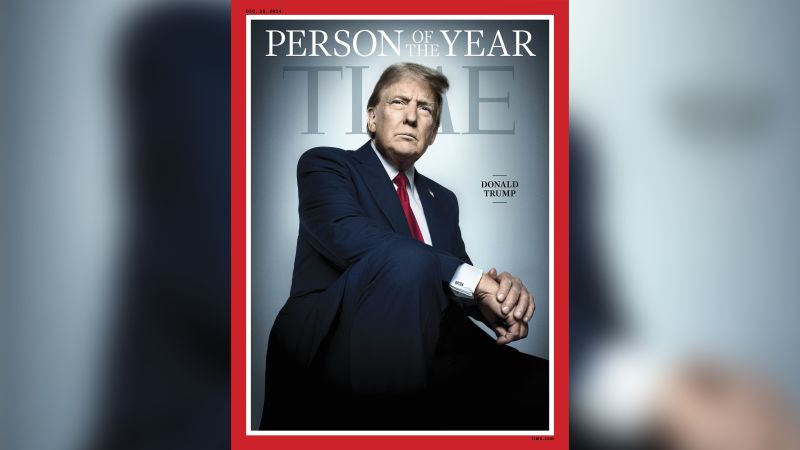
US President Donald Trump has once again sharply criticized the media’s portrayal of him, this time with a particular focus on the recent cover of “Time” magazine. While the article focusing on his Middle East ceasefire was viewed quite positively, the magazine cover met with strong opposition from Trump. His main criticism was the editing and perspective of his photo, fueling an interesting debate about media representation and public opinion in the US.
Trump Criticizes the “Time” Magazine Cover: A Media Controversy
“Time” magazine dedicated its cover to former US President Donald Trump to honor his role in promoting a ceasefire in the Gaza Strip. However, the politician’s keen interest was less in the content of the article than in the image chosen for the magazine cover. Trump expressed disappointment and surprise on his online service, Truth Social, about the portrayal of his photo, which was taken from below and allegedly appears unflattering.
The photo’s perspective, criticized by Trump, particularly highlights his neck and makes his hair appear unusually lit. This led him to remark that his hair had virtually “disappeared” on the cover and was rendered unrecognizable. He commented on the description of a “floating crown” on his head as an “extremely small” and “truly strange” element.
Media criticism and public perception in the US: Trump’s relationship with “Time” magazine
Time has featured Trump on its covers several times, with 41 covers to date—an enormous degree of media exposure surpassed only by Richard Nixon’s 55. It’s notable that the magazine has honored the former president as “Person of the Year” twice, following Trump’s victory in the 2016 and 2024 presidential elections.
While Trump praised the article about his ceasefire plan in the Middle East conflict, calling it “relatively good,” he made it clear that the “magazine cover might be the worst ever.” These differing assessments reflect the complex relationship between politics, the media, and public opinion in the United States, where media staging often becomes a contentious issue.
The Cover Photo in Focus: Image Editing, Perspective, and Trump’s Displeasure
| Aspect | Description | Trump’s Criticism |
|---|---|---|
| Photo Perspective | Photo taken from below, emphasizes neck and blurred background | Doesn’t like the shot from below, looks unflattering |
| Image Editing | Head hair has been edited, hair appears to have “disappeared” | Claims hair has “disappeared” and a small crown appears to be floating on the head |
| Public Impact | A polarizing image that is being hotly debated | Worst photo ever on a cover |
Trump’s experience underscores how imaging and media staging can strongly influence images of a politician. The public perception of politicians is thus also shaped and reflected by photographic representations and their editing in prestigious media outlets such as Time magazine.
Media Landscape and Political Communication in the USA 2025
The controversy over the Time magazine cover exemplifies how closely politics, the media, and public opinion are intertwined. It also highlights the importance of media literacy and a critical approach to the press and magazines. The way the media portrays leaders is also understood as a reflection of contemporary political culture.
American politicians and media outlets like Time therefore play a central role in shaping public narratives and political opinion. Especially in times of complex political conflicts and societal challenges, this shapes the perceptions of a broad public.
This debate also sheds light on the tension between politicians’ personal rights and freedom of the press, which requires questions of ethics and responsibility in media reporting to be continually renegotiated. For further analysis and context, it is worth taking a look at comprehensive articles on Trump’s political visions and current media-critical debates:
- Donald Trump’s Vision of Peace
- ECB President Lagarde Subtly Criticizes Trump
- Nietzsche and Media Criticism
- Trump’s Controversial Claims about Autism
- Pope Leo XIV Criticizes US Immigration Policy
Source: www.n-tv.de